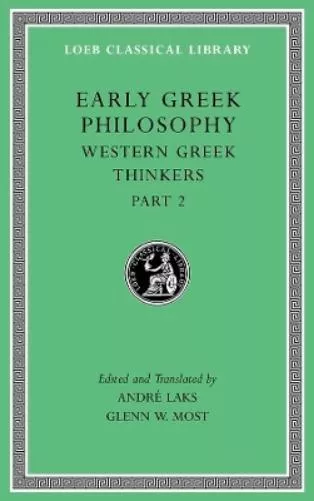
Western Greek Thinkers, Part 2
Volume V of the nine-volume Loeb edition of Early Greek Philosophy includes the western Greek thinkers Parmenides, Zeno, Melissus, Empedocles, Alcmaeon, and Hippo.
A major new edition of the so-called Presocratics.
Thefragments and testimonia of the early Greek philosophers (often labeledthe ‘Presocratics’) have always been not only a fundamental source forunderstanding archaic Greek culture and ancient philosophy but also aperennially fresh resource that has stimulated Western thought until thepresent day. This new systematic conception and presentation of theevidence differs in three ways from Hermann Diels’s groundbreaking work,as well as from later editions: it renders explicit the material’sthematic organization; it includes a selection from such related bodiesof evidence as archaic poetry, classical drama, and the Hippocraticcorpus; and it presents an overview of the reception of these thinkersuntil the end of antiquity.
Volume I contains introductory and reference materials essential for using all other parts of the edition.
VolumeII presents preliminary chapters on ancient doxography, thecosmological and moral background, and includes the early Ionianthinkers Pherecydes, Thales, Anaximander, and Anaximenes.
Volume III includes the early Ionian thinkers Xenophanes and Heraclitus.
VolumeIV presents Pythagoras and the Pythagorean School, including Hippasus,Philolaus, Eurytus, Archytas, Hicetas, and Ecphantus, along withchapters on doctrines not attributed by name and reception.
Volume V includes the western Greek thinkers Parmenides, Zeno, Melissus, Empedocles, Alcmaeon, and Hippo.
VolumeVi includes the later Ionian and Athenian thinkers Anaxagoras,Archelaus, and Diogenes of Apollonia, along with chapters on early Greekmedicine and the Derveni Papyrus.
Volume VII includes the atomists Leucippus and Democritus.
VolumeVIII includes the so-called sophists Protagoras, Gorgias, Prodicus,Thrasymachus, and Hippias, along with testimonia relating to the life,views, and argumentative style of Socrates.
Volume IX includes the so-called sophists Antiphon, Lycophron, and Xeniades, along with the Anonymous of Iamblichus, the Dissoi Logoi, a chapter on characterizations of the ‘sophists’ as a group, and an appendix on philosophy and philosophers in Greek drama.